Corpus Christi and L’Ou com Balla | Barcelona
 The first Corpus Christi celebration in Barcelona dates back to 1320, when people began to mark the day for religious teaching and moral purposes. At the time it was Barcelona’s main festival, and it consisted of a procession of the Blessed Sacrament, with a first, popular section featuring the entremeses (theatrical performances, in this case of characters from the Bible) and a second, religious section carrying the monstrance with the Blessed Sacrament on the throne of Martí l’Humà.
The day is still celebrated in Barcelona, and it still has a religious side, although it’s celebrated in a more festive way, with characters and activities that have gradually joined the festivities and are now traditional, such as the giants, the ‘capgrossos’ (big heads), the Drac (dragon), the castellers (human towers), the balls de bastons (stick dances), etc.
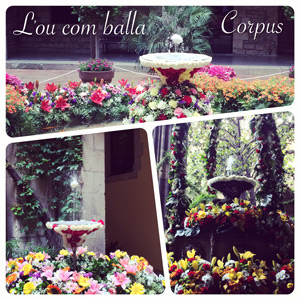
The most curious tradition, which is known to have been held in the Cathedral Cloister since 1440, is ‘L’Ou com Balla’ (the dancing egg). An empty eggshell is set dancing on top of the jets of the city’s fountains, and the whole base of the fountain is decorated with flowers and plants.
There are several versions of where this custom comes from, ranging from the religious, symbolising the moment of the Elevation of the Host, to fertility and abundance, or simply a game.
Today you can see ‘l’ou com balla’ in several places, most of them in Barcelona’s historic centre:
- Seu de la Catedral, Claustre (Pla Seu 3)
- Reial Acadèmia de Bones Lletres (C/Del Bisbe Caçador 3)
- Arxiu de la Corona d’Aragó – Palau del Lloctinent (C/dels Comtes 2)
- Museu Frederic Marès (Pl. de Sant Iu 5)
- Arxiu Històric de la Ciutat de Barcelona – Casa de l’Ardíaca (C/Santa Llúcia 1)
- Jardí de Rubió i Lluch (C/Hospital 56)
- Ateneu Barcelonès (C/Canuda 6)
- Parròquia de Santa Anna (C/de Santa Anna 29)
- Parròquia de la Puríssima Concepció (C/Roger de Llúria 70)
- Reial Monestir de Santa Maria de Pedralbes (Baixada del Monestir 9)
- Taller Escola Sant Camil (C/de Sales i Ferré 60)
- Capitania General de Barcelona (Passeig de Colom 14)
- Jardí del Museu Marítim (Av. Drassanes 1)
- Jardí interior Carrer Elisabets (C/Elisabets 1)
- Centre cívic Can Deu (Pl. Concòrdia 13)
- Taller Escola Sant Camil (C/Ercilla 57)
Finally, it’s worth mentioning that one of the most traditional Corpus festivals to have survived over time is the Patum de Berga, the only form of Catalan cultural expression declared a Masterpiece of the Oral and Intangible Heritage of Humanity by UNESCO. From the Wednesday to the Sunday of that week, the old processional entremeses, which have now become festive troupes, spread out into every corner of the town of Berga.
Here you can find more detailed information about Corpus in Catalonia.
Corpus Christi falls sixty days after Easter Sunday, so the date changes every year depending on when Holy Week falls.
More photos of Barcelona on Instagram: @anotherbcn