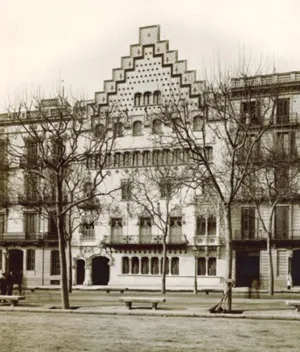
The ‘Fabra i Coats’ spinning mill
Despite the successive crises suffered by the Catalan textile industry, the Fabra i Coats spinning mill didn’t fall out of use until 2004. Its success was down to its excellence in every sense: it was innovative in technical terms (a pioneer in making synthetic threads, in manufacturing processes that guaranteed a ‘just in time’ service, and in specialising in high-tech products) and it showed a particular concern for social issues (staff training, its own sports facilities, housing built for its employees and crèches for the workers’ children).

At the beginning of the 20th century, the company was a pioneer in Spain in making cotton thread for sewing, embroidery and net-making. It was formed in 1903 from the merger of two large textile companies, one British (Coats & Clark) and one Catalan (Fabra y Portabella).
Now, thanks to the persistence of local residents, some of them former workers, this space of around 12,000 m² is to become a cultural centre that preserves the historical memory of the factory as far as possible.
A former worker at the factory, who lives in the neighbourhood and is proud to have been part of this company, which still exists, explained the ins and outs of every corner to us.
He sounded the siren just like in the old days, and I pictured people streaming out of the factory in their dirty work clothes, tired but smiling at the thought of going home. Mind you, it almost deafened us, and he told us the real sound was seven times louder so it could be heard over the machines!
There were fire hydrants everywhere, and little signs on every corner of the many buildings telling you exactly where they were, with the direction and the distance.

The boilers, which came from an old English ship, were impressive. As the factory grew, more boilers had to be added. Each one was taller than the last, so a higher roof had to be built.
It’s being refurbished at the moment, but the MUHBA will soon be organising guided tours of this historical and cultural complex.
Interestingly, the building that lies outside the factory’s present-day enclosed site, known today as Can Fabra, was one of the sheds that made up the industrial complex founded by Ferran Puig i Gibert in 1838.
Location: C/Sant Adrià 20, Barcelona
Getting there: Sant Andreu metro (L1)
More photos of Barcelona on Instagram: @anotherbcn