Wallace fountains in Barcelona
Do you know the Wallace fountains? If you don’t, you may well have noticed one at some point without meaning to, because although they’re discreet, they’re very charming and they stand in fairly busy spots.
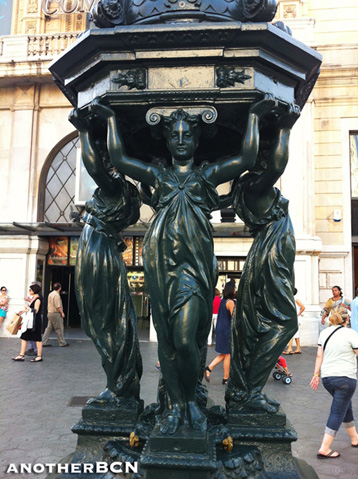
They’re dark green wrought-iron fountains, with 4 caryatids holding up a small dome. Each figure, all of them different, represents a virtue (Kindness, Simplicity, Charity and Sobriety), and these in turn represent the 4 seasons of the year: winter, spring, summer and autumn respectively.
These fountains originated in Paris. Richard Wallace, a Briton with a vast fortune, decided to use it to fund social projects in Paris. Among other things, he paid for around a hundred fountains to be built, with both public health and artistic aims in mind. The work was commissioned from the sculptor Charles Lebourg, with a set of clear instructions: they had to be big enough to be seen from a distance without spoiling the harmony of the landscape, and they had to combine usefulness and beauty, be reasonably priced and be made from a durable material that was easy to work.
As well as the fountains for Paris, around 50 more were made and given to various cities around the world. Of these, 12 ended up in Barcelona, as a gift to Rius y Taulet for the 1888 Universal Exhibition.
Today, of those 12, only 2 remain: one on La Rambla, opposite the Wax Museum, and another on the corner of Gran Via and Passeig de Gràcia. There are others around the city known as Neo-Wallace, because they were cast from the old moulds, but they don’t date from that period.
View Wallace fountains in a larger map
More photos of Barcelona on Instagram: @anotherbcn