La Boqueria market
 La Boqueria is a market that has always drawn me in, for all sorts of reasons. Above all its colours, its smells and its atmosphere. A few years ago I went to photograph its charms, but it’s always hard to capture what you want to convey.
La Boqueria market has had several locations since its beginnings, which date back to 1217. But it wasn’t until 1840, as a growing number of street markets were crying out for some kind of order, that the first stone was laid of the market as it is today, on the site where it still stands.
The origin of the name Boqueria is a matter of debate; the most widely accepted theory, also applied to the market’s other name, the Mercat de Sant Josep, is that it may come from the tables where goat meat, or boc (Catalan for billy goat), was sold here.
Today La Boqueria is Barcelona’s star market. Its location, its structure, the Ionic colonnade that surrounds it and the atmosphere you soak up there make it one of the most iconic markets not just in Barcelona but in the whole country.

Midday. La Boqueria is buzzing. Colours, smells and sounds mingle in a sea of sensations. You can spot all kinds of characters, from tourists to youngsters who’ve come along with their grandparents to do a proper shop.
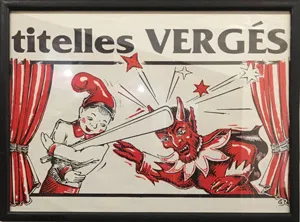
At one of the first stalls by the main entrance there’s an eye-catching, strategically placed sign that beckons in anyone who may not yet know the market’s charms. The grand entrance turns into a wide aisle lined with fruit and vegetables that have gradually adapted to the tastes of passers-by. This aisle is the market’s main artery, and narrower, medieval-style alleyways cut across it all the way along.
Bright light from above floods the entrance and fades away along the aisle, where perfectly aligned steel lamps do their job of lighting up the gloom. The iron structure of the roof has stood the test of time.

But it isn’t only tourists who come into the market. In its narrow alleyways, almost impassable because of all the trolleys going back and forth, you’ll find people who want a good meal at the little restaurants in the middle of the market, and the loyal shoppers: those who buy every day, those who come once a week, and those who drop in now and then. You see all sorts of people, of every age, culture, religion and nationality.
Amid the murmur you can make out age-old phrases such as ‘¿Querrá lo de siempre señora Pepita?’ (The usual, Señora Pepita?), ‘¿A cómo va el quilo?’ (How much a kilo?) and ‘Perdone, pero iba yo antes’ (Excuse me, but I was first).
Technology is slow to arrive, and the most modern things you’ll see are metal scales and sharp-bladed knives. Expert hands work at a frantic pace. Every food has its tool. Take the coconut, for instance, which is hammered open so that its flesh, though not its milk, can be used. Hands with and without gloves, old and young, wrists with and without watches, skin of different shades… Behind every task there’s an expert, most of them hard at work since the early hours.

From one stall to the next, the colours and smells of the food don’t go unnoticed. You can find every kind of food. Fruit, vegetables, fish and meat are the most plentiful. But you can also find sweets, which are bought not only by children but by people of all ages, as well as mushrooms, nuts, insects, eggs and more. Keeping up with the new habits of today’s shoppers, you can even find fruit salad packed in plastic tubs.
There’s life around the outside of La Boqueria too. Restaurants and other stalls border the market among the Ionic columns. One of the classic restaurants here is Bar Pinocho. Under the arches, sheltered from the sun, some Romanian women have a snack before carrying on begging.

Midnight. Calm descends. While a sea of people wanders along the Ramblas, silence and solitude shelter La Boqueria. Its deserted aisles call to night-time souls looking for refuge. Souls who wait. Wait for the day when everything will be better.
A cook steps out of a back door for a break. He lights a cigarette and a sense of calm washes over him. A few minutes’ rest is enough to recharge his batteries and go back to the hard graft of the restaurant. He tells me to be careful: these aren’t places for a woman to wander alone with a camera. Voices can be heard in the background, laughter, motorbikes; a conversation between two prostitutes rises above the murmur. ‘Si bonita, si que tengo un pitillo’ (Yes, love, I’ve got a ciggie), one says to the other. I ask if I can take their photo, but their answer is obvious: ‘chiquilla, ¡aquí cobramos por todo!’ (Sweetheart, round here we charge for everything!) I smile at them and thank them. These characters practise an age-old profession that knows no borders.

I head off down a slightly busier passage to reach the back of La Boqueria. Every now and then a group of young people cuts through this street without giving a second thought to the stalls, which, stripped of their colour, go unnoticed.
A piece of graffiti on the far wall brings us back to the present day and shows how street art can decorate a city. These strokes of modern art also appear, more discreetly, on the two columns in the foreground, where a small heart hints at a fleeting romance.
A recently emptied bin seems to sway to the rhythm of the silence. Its presence is pointless: night-time antisocial behaviour has taken over the city, and leftover plastic cups and other rubbish, ashamed of themselves, try to hide in the shadow cast by the wall.
In the sky, beams of light from the palace on Montjuïc, which were once used as anti-aircraft searchlights during the war, can be seen in the distance and lend an air of grandeur to the market, which at this hour of the night has been reduced to structures of iron and metal waiting for dawn.

When I reach the back of La Boqueria, I realise it isn’t completely calm. Its dark, silent streets hide the people whose job is to collect the rubbish. It’s time to throw out the scraps.
Opposite this scene, old and new blur together. A car park separates some crumbling walls from a fashionable restaurant. On one side, some public toilets among the rubble wait to be used, and a pile of clothes on the ground, once useful to some, becomes a flea market for others; meanwhile, at the other end, people talk about politics, holidays, family, work and so on.
And so the days go by. The secrets this market could tell us! The things it has lived through! The passing of time shows in its structure, its stalls, its alleyways, its little lanterns… but it’s still there, as strong as on the first day, with thousands of stories to tell that are slowly being forgotten.
To see more photos, here.
Address: La Rambla 91, 080021 Barcelona
Open every day except Sunday, from 6am to 9pm.
View La Boqueria market in a larger map
More photos of Barcelona on Instagram: @anotherbcn