The festival of La Mercè
 The Virgin of La Mercè, Barcelona’s current patron saint, ‘stole’ the title from Santa Eulàlia, a girl whose humility and devotion were well beyond her years. Eulàlia reigned as patron saint until 1868, when the Virgin of Mercy (la Merced) became patron saint of Barcelona, leaving Santa Eulàlia as co-patron. They say it always rains around the time of La Mercè, and that’s because Santa Eulàlia is weeping over the loss of her place at the head of the city.
Legend has it that on the night of 24 September 1218 the Virgin appeared to Jaume I, Saint Raymond of Penyafort and Saint Peter Nolasco, asking them to create an order devoted to caring for Christians imprisoned by the Saracens. These were times of religious wars: the Mediterranean was dominated by Muslims, and Saracen pirates took thousands of people captive and carried them off to Africa. Peter Nolasco created the Celestial, Royal and Military Order of Our Lady of Mercy, founded in Barcelona Cathedral with the support of Jaume I the Conqueror. The order’s aim was to redeem captives. In its early days it was a purely military order, whose members, the Mercedarians, took a fourth vow: to free others who were weaker in the faith, staying behind as hostages if necessary. Its first name was the Order of Santa Eulàlia. As a military order they conquered the Balearic Islands and Valencia, and Jaume I granted them a coat of arms made up of the four red bars on a gold background, with the distinctive cross of Barcelona Cathedral and the royal crown added as a symbol of royal protection. The Virgin Mary, making herself known as La Merced, wished to show her mercy towards captives through this order devoted to caring for them and setting them free. It’s estimated that around three hundred thousand people were redeemed by the order’s friars. In 1265 the first nuns of La Merced appeared.
A few centuries later, in 1687, Barcelona was struck by a plague of locusts, and the city put itself in the hands of the Virgin of La Mercè; once the plague had been wiped out, she was named patron saint of Barcelona. But the Pope didn’t ratify the decision until 1868, the year in which the Virgin of La Mercè was officially named patron saint of Barcelona.
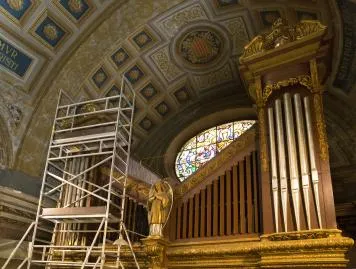
The carved image of the Mother of God of Mercy in Barcelona’s Basilica de la Mercè dates from the 14th century (1361); seated on a throne in the Romanesque manner, it’s the work of Pere Moragues. In Catalan she is called ‘Mare de Déu de la Mercè’.
It was with the backing of Francesc Cambó that, on 24 September 1902, the first festa major (main festival) dedicated to the new patron saint was held, and it has carried on to this day.
Nowadays there are loads of activities in venues all over the city, focusing on Mediterranean and Catalan culture. In less than a week Barcelona puts on a programme for every taste: street arts, parades, trabucaires (blunderbuss firers), correfocs (fire runs), castellers (human towers), sardanas (Catalan circle dances), concerts, sporting activities, a photography competition and, finally, to close the festival, the piromusical (fireworks set to music).
To see the festival programme, click here.
More photos of Barcelona on Instagram: @anotherbcn