Santa Eulàlia and Barcelona
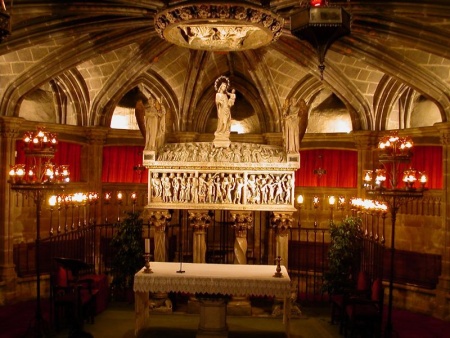
Oh! Poor little Santa Eulàlia, how much she suffered and how little we remember her. A forgotten myth. But Barcelona has several places that do her justice. To begin with, Barcelona Cathedral is dedicated to her – its name is the Cathedral of the Holy Cross and Saint Eulalia – and beneath the altar lies the Crypt of Santa Eulàlia, where her remains are supposedly buried in an alabaster tomb resting on 8 columns, with her whole story depicted on it. Santa Eulàlia’s remains went missing for centuries and were rediscovered in Santa Maria del Mar, from where they were carried in procession to the cathedral, where they lie today. Nowadays the crypt is only open on Santa Eulàlia’s day, 12 February, a tribute to the little girl so that we pay her a bit of attention.
The legend, first recorded in the 7th century, goes back to Roman times, to the 2nd century, when Christianity had not yet established itself as a religion. It’s said that Eulàlia, a girl of 13, chose to declare her faith openly to the Roman authorities, and they martyred her. She endured 13 tortures, one for each year of her life. The one you hear about most, which has a street named after it in the Gothic Quarter, the Carrer de la Baixada de Santa Eulàlia, is when they put her inside a barrel full of broken glass, nails and knives and rolled it down that slope, which used to be twice as long. Today, if you look up at the top of the street, you’ll see a small figure of the virgin martyr and a poem dedicated to that moment, from which Santa Eulàlia emerged unharmed. Finally, after all the tortures, they crucified her on an X-shaped cross, which, together with a feather, is the unmistakable symbol of this virgin and the emblem of the cathedral.
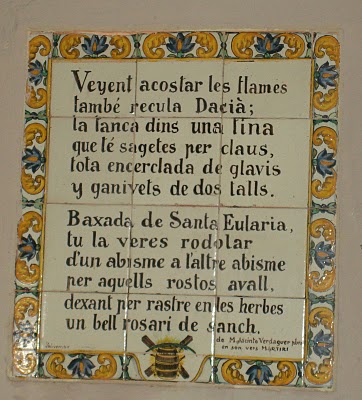
Other places in Barcelona honour her too, such as the Passeig de Santa Eulàlia or the Carrer de l’Arc de Santa Eulàlia, where legend has it she was held prisoner for a long time, and where there’s also a small figure of her. Or squares such as the Plaça del Padró, the Plaça de l’Àngel or the Pla de la Boqueria, where it was said she was crucified and where there are statues dedicated to her.
She was 13 years old, she endured 13 tortures, and there are 13 white geese living in the cloister, representing the purity of this girl (they also say that Eulàlia, the daughter of a noble Barcelona family, used to herd geese on her family’s land in Sarrià).
She was canonised and named patron saint of Barcelona in 633. But in 1868 she lost her patronage to the Mare de Déu de la Mercè (Our Lady of Mercy), who is the city’s patron saint today and to whom we owe La Mercè, the city’s main festival, on 24 September.
Nobody knows whether Santa Eulàlia really existed, but what is certain is that a cult grew up around her. A Barcelona woman – brave, strong and fair – who stood up for her ideals and convictions. So don’t forget Santa Eulàlia, ‘la que parla bé’ (she who speaks well). And I’d encourage you to look out for references to her around the city.
Have a look at this blog for more information about Santa Eulàlia.
And here’s a documentary dedicated to ‘la que parla bé’ (she who speaks well), which is what the name Eulàlia means.
More photos of Barcelona on Instagram: @anotherbcn