The shrine of Santa Maria de Collserola
Carretera de les Aigües, 9pm.
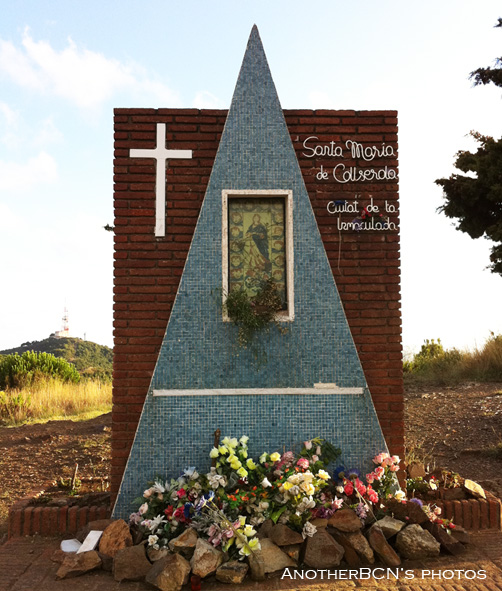
After running a few km in good company, my ‘coach’ showed me Santa Maria de Collserola, on the way to Turó d’en Cors, one of the high points of the range.
It’s a small, simple shrine of brick and tiles, with an image of Santa Maria de Collserola who, from her tiny glass case, broken ‘per un cop de roc llançat amb massa traça’¹ (by a stone thrown with too much skill), gazes at the Sacred Heart on the very top of Tibidabo.
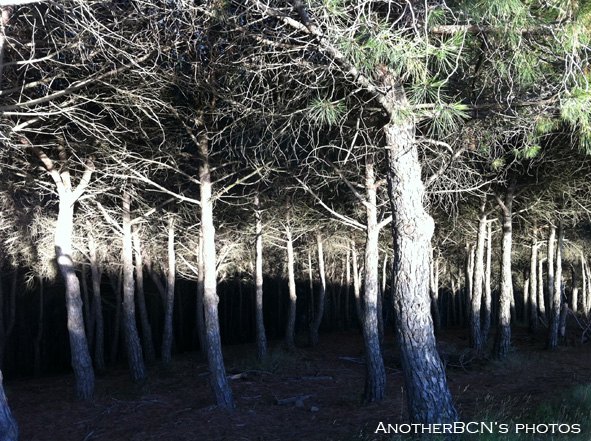
You reach this spot (which is above roughly km 6 of the road) along surprisingly leafy, narrow little paths, through a rather gloomy forest where it looks as if giants have forced their way through, knocking down the pines that stood in their path.
The thing is, the snowfall two years ago uprooted the weakest pines in the forest, true to the theory of evolution.
The truth is that the charm of the place has brought me back several more times in a short space of time, always with some story to tell.
Only yesterday, on one of the narrow, leafy paths, a cyclist overtook me at a moderate speed.
Suddenly I heard a noise further down, but I ruled out a fall because it was too soft a sound.
But imagine my surprise when, a few metres further down, I came across the cyclist, swallowed up by a bramble bush!
Hence the soft noise, although for him there was nothing soft about it. My first reaction was alarm, and I asked him if he was OK. When I saw he only had a few scratches, and after he told me he was fine, my next reaction was to smile, and so did he. Because, unfortunate as it was, the situation was still funny.
Anecdote aside, I’d encourage you to explore the forests of Mordor, by bike or on foot, in search of mysterious giants and the Virgin of Collserola.
1. A reference to the poem ‘La vaca cega’ (The Blind Cow) by Joan Maragall.
View Santa Maria de Collserola in a larger map
More photos of Barcelona on Instagram: @anotherbcn