Rambla Catalunya, the Coqueta giraffe and the Pensador bull | Barcelona
Rambla de Catalunya is a Barcelona boulevard that has always stood in the shadow of Passeig de Gràcia and the Ramblas, yet it too has a special, stately charm that draws visitors and locals alike all year round.

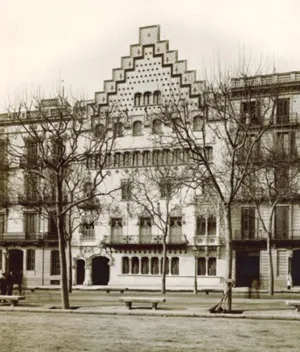
With restaurants and cafés, century-old shops, Catalan Art Nouveau (Modernista) buildings and the odd church and art gallery, Rambla Catalunya is the place for a leisurely stroll in the shade of the lime trees.
It’s worth stopping to take a look at some lovely or unusual places such as (in order, heading down from the Diagonal):
- The Casa Serra by Puig i Cadafalch, from 1908, now the headquarters of the Diputació de Barcelona, the provincial council (on the corner with Diagonal).
- The church of the Mare de Déu de Montsió (Rbla Cat no. 115), which moved around Barcelona several times before reaching its current location.
- La Bodegueta restaurant (Rbla Cat no. 100), from 1942, an authentic spot that smells of wine from the barrel, reached down a narrow flight of stairs, where they serve delicious tapas and small plates.
- The Bolós pharmacy (Rbla Cat no. 77), in Modernista style, with a wooden door and leaded glass.
- The Villà hardware shop (Rbla Cat no. 54), from 1912 and also in Modernista style, where, they say, customers are still served just as they were in the last century.
Other landmark shops on Rambla Catalunya are now history, such as the Quílez grocery (colmado), one of the most iconic in Barcelona, or the Prats art gallery, which had once been a hat shop.

At either end of Rambla Catalunya, the boulevard is marked by statues of humanised animals with an ironic touch. By Gran Via stands the toro Pensador (the thinking bull), and on Avinguda Diagonal the jirafa Coqueta (the flirtatious giraffe) takes you by surprise. Both statues are by Josep Granyer and are inspired by masterpieces, Rodin’s The Thinker and Antonio Canova’s Pauline Bonaparte respectively.
These pieces came about through a campaign by the ‘Amics de la Rambla de Catalunya’ association to protect the boulevard from a devastating plan to turn the rambla into a main traffic artery. So they turned to art to stop it, selling the boulevard as a park of sculptures by Josep Granyer. The project saved the rambla but was never fully carried out: instead of the ten statues that were meant to decorate each of the boulevard’s corners, only the first and the last were made, the Coqueta giraffe and the Pensador bull.
Here on the blog, we’d like to thank these small associations, whose effort and determination have succeeded in preserving little treasures of Barcelona.
>> Sponsored post by Company registered address in Barcelona.
More photos of Barcelona on Instagram: @anotherbcn