Abat Oliba University: a few curiosities
Barcelona is a destination for students from all over the world for a number of reasons, but above all for its high academic standards: the city is home to some of the most important universities and master’s programmes, the ones that appear in the best-known rankings.
Then there’s its setting, between the sea and the mountains, its mostly sunny climate and the history you can feel in the walls of the Gothic Quarter or El Born, all of which make it an even more attractive city for anyone from abroad.
There are several universities in Barcelona offering a wide range of courses, and many of them pay tribute to a historical figure, whether through their origins or their name.
This time we’ll talk about the university that bears the name of Abat Oliba (Abbot Oliba), a Catalan Benedictine monk who lived in the Middle Ages (971–1046). He was the great-grandson of Wilfred the Hairy (Guifré I el Pilós) and, although he was the son and grandson of counts, he gave up his noble lineage to become a monk and later an abbot. His position, learning and intellect helped him foster cultural ties with the rest of Europe and sponsor the founding and reform of monasteries. He was a writer and promoted the creation of a school of Latin poetry.
Several Catalan institutions, especially educational ones, have taken the name of this great intellectual in his honour.

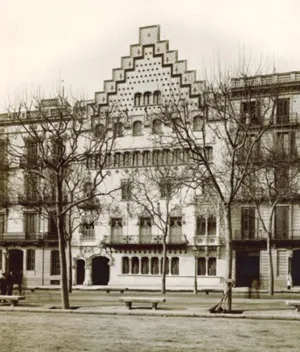
The building, protected by Barcelona City Council as part of the city’s historic heritage, is surrounded by gardens and was once, together with the land occupied by the Torre de Bellesguard, the palace of Martin the Humane (Martí I l’Humà).
Later the Convent of the Redeemer was built there, with its Church of the Oblates of the Most Holy Redeemer, designed by Bernardí Martorell, an architect and disciple of Gaudí.
In 1973 the Fundación San Pablo CEU converted the convent to found the Universitat Abat Oliba CEU. The cloister and the church were kept completely intact; the church is now the university’s Aula Magna (great hall) and one of the most characteristic examples of Catalan Modernisme (Art Nouveau).
More photos of Barcelona on Instagram: @anotherbcn