Poblenou Cemetery
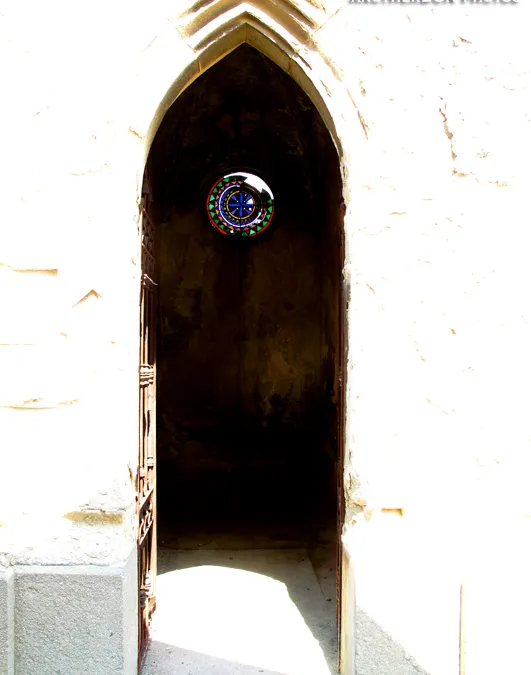
 For days I’d had it in mind to visit this place (Poblenou Cemetery), until the other day I decided to go at midday. Not a bright idea, as the sun, in all its voluptuousness, was mercilessly scorching the world of the dead and that of the living. But there we were, silence and I, ready to share our solitude along a route I improvised, having done barely any reading beforehand. A leaflet I picked up at the entrance marked the spots of greatest interest and suggested a route, which I decided not to follow in the set order. Suddenly, a state of peace flooded the whole world and time stood still. It stood still in each of the cemetery’s niches, it stood still in the yellowing photos placed there as mementos, it stood still in the plastic flowers and the dried flowers, it stood still in the mausoleums, in the statues and in every one of the epitaphs.
The origins of Poblenou Cemetery (also known as the Cementiri Vell, the Old Cemetery, or the East Cemetery) date back to 1775, when Bishop Josep Climent made a first attempt at creating one, which would become the first cemetery outside the city walls for the people of Barcelona. Before long, this burial ground was destroyed by Napoleon’s troops because it got in the way of their military defence strategies. In any case, nobody wanted to be buried in that unconsecrated place, far from the city and away from the churches, so it was little used and only the poor who died in hospitals ended up there. Nothing remains of that first cemetery today.

By then the small church graveyards were starting to fill up, and it wasn’t unusual to find human remains in the River Besós. Poor sanitation was becoming a problem, and it was in 1819 that the present-day Poblenou Cemetery was created, at the initiative of Bishop Pau Sitjar and rebuilt by an Italian architect, Antonio Ginesi, who would himself be buried in the same cemetery five years later, at the early age of 33. After his death, changes were made to the original design to make more profitable use of the space.
The cemetery is Neoclassical in style, with Egyptian influences, and it is said that Ginesi may have been a Freemason, although there is no record of it, because of his use of such a key symbol as the pyramid. On the main façade, on either side of the entrance, there are pyramid shapes with an opening in the middle: the all-seeing eye. The work was criticised for its architectural style. It was also laid out in four areas of uniform niches, in keeping with the new moral values and social ideals that were taking hold in the city.
The bourgeoisie, who wanted to show off even after death, demanded an area for mausoleums, and so in the mid-19th century the cemetery was extended to meet that need.
So there were three kinds of places to drop dead in: for the less well-off, the common grave was their destination; for the middle class there were niches; and finally, for the upper class, mausoleums were built. It’s in this last area that the statue ‘El beso de la muerte’ (The Kiss of Death) stands, one of the most spectacular sculptures in the cemetery, carved in 1930. It’s signed by Jaume Barba, although it’s attributed to Joan Fontbernat Paituví.

Poblenou Cemetery was built just in time to take in the more than six thousand bodies left by the yellow fever of 1821. In memory of the tragedy, there is a monument, also the work of Ginesi.
Of all those laid to rest in this cemetery, there are a few who will live on in memory, among them Mari Santpere, Narcís Oller, Lola Anglada, Narcís Monturiol, Josep Anselm Clavé (his tomb is the first work by Lluís Domènech i Montaner), Valentí Almirall, José Luis Villalonga and El Santet, ‘the little saint’ (Francesc Canals i Ambrós), at whose grave even now you’ll find flowers and candles left for this young man, who died in 1899 at the age of 22 and was much loved by his neighbours for his kindness and devotion to others. Little is known about him, but his grave is still a place of pilgrimage, and lots of people leave messages, offerings, requests, flowers…
Guided tours: first and third Sunday of the month.
Night tours: there are 2 night tours of Poblenou Cemetery a year. There’s usually one in March/April and another in October/November. We’ll let you know about the next one through the another BCN Facebook group.
More detailed information about Poblenou Cemetery.
Address: C/Taulat 2, 08005 Barcelona
Opening hours: 8am–6pm
View Cementiri Poblenou in a larger map
More photos of Barcelona on Instagram: @anotherbcn